Showing posts with label kimono. Show all posts

Sunday, 7 April 2013

Kimono at the Morris Miller Library (UTAS Sandy Bay Campus)


Kitsune
Kimono and Kitsuke Club
presents:
Kimono at the Morris Miller

With its dangling sleeves and decorative sash, kimono is the instantly recognisable national dress of Japan.
The modern kimono takes its current form from the garments worn by wealthy samurai women and the upper class in the 1800s when Japan underwent a period of rapid modernisation known as the Meiji Restoration.
It was in the 1920s and ‘30s, with the rise of department stores and prêt-à-porter (ready to wear) kimono that the garment became an everyday style and fashion item.
The garments on display come from the kimono collection of Emerald King, a recent PhD graduate of the (former) School of Asian Languages and Studies and current President of TUU Kitsune: Kimono and Kitsuke Club.
(With thanks to Bec Muir - Kitsune Treasurer - for her wedding accessories and Hitomi Yoshida - Kitsune VP - for her mens yukata)
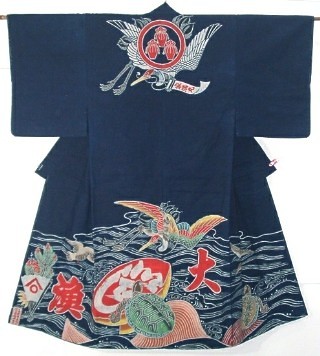
Items date from the mid Shôwa period (1926-1989) to modern day.

The exhibition is free and will run for the month of April at the Morris Miller Libray, UTAS Sandy Bay campus. (Opening hours here: http://www.utas.edu.au/library/about-us/our-libraries/morris-miller-campus-library/opening-hours)


Thursday, 3 January 2013

Kitsune presents: 2013 AiCON Kimono Competition Entry Details


Kitsuné Kimono Competition

BRAND SPANKING NEW for 2013, Kitsune is proud the present one of AiCon’s newest events – the Kimono Competition:
Part Fru!ts, part Cosplay, all Kimono!!

Categories

Competitors of all ages, genders and kimono experience are invited to join and compete in one of three criteria:
TRADITIONAL, NOUVEAU and COSPLAY.


Competitors in the Traditional category will be judged on the formality and the neatness of their kitsuke (the way they have put the kimono on) as well as the propriety of their ensemble (have they teamed an appropriate obi with their kimono? are they wearing the correct footwear for the formality of their ensemble, ie. geta with yukata or zori with kimono). There are no restrictions placed on the formality or the seasonality of the yukata/kimono entered into this category so along as the competitor is wearing a cohesive ensemble. Competitors with long hair should style their hair in an up-do such as a neat bun. It is recommended that only simple jewellery is worn. Likewise makeup should be kept clean and subtle and, if possible, hair should be a relatively natural colour (blonde, red, brown, black as opposed to pink, green or purple).


Competitors in the Nouveau category have a larger degree of freedom in regards to makeup, hairstyle and accessories, however each competitor should be able to give an explanation for their choices when queried by the judges. This category will cover both street (kimono hime) style and wa-lolita (wa-lolita will be judged with particular emphasis on fabric patterns and accessories. Efforts should be made to emphasise the ‘wa’ elements of the outfit through the choice of footwear and accessories). While the rules are more relaxed than the Traditional category, if a competitor is wearing their kimono or yukata without, for example, a defined o-hashiori (waist fold under the obi sash) they will need to be able to justify this choice to judges when queried.


Competitors in the Cosplay category will be required to wear a cosplay of a kimono wearing anime, manga or game character such as those from Ruroni Kenshin, Sakuran, Hell Girl, Samurai Warriors or even Bleach. Most anime and manga include an episode in which characters wear kimono or yukata during festivals and New Years’ celebrations including Love Hina, xXx Holic and even Sailor Moon. Competitors in this category will be judged not only the accuracy with which they portray the character they are dressed as but also on their fabric choices and the accuracy of the kimono elements of their cosplay. For example, where possible Japan-ese fabrics such as silk, cotton and hemp should be used instead of satin, Chinese brocade, jersey or cotton drill. Pre-purchased cosplays may be entered into this section with the proviso that they fit the above requirements.

The judges reserve the right to award a fourth ‘judges choice’ award if they feel there is a competitor of particular merit who deserves recognition.

The example images are all of the current Kitsune President, Midori Emerald and date from 2005-2012.

Competition Rules

    1. Competitors must enter into one of three categories – Traditional, Nouveau or Cosplay – as defined above.
    2. No single competitor may enter in multiple categories.
    3. There will be one award per category. The judges reserve the right to award a fourth ‘judges choice’ award if they feel there is a competitor of particular merit who deserves recognition.
    4. All kimono ensembles and cosplays entered into the competition may be compiled, commissioned or constructed (as long as they meet the criterion for each category introduced above). No preference will be given to constructed costumes.
    5. Competitors are free to dress in ensembles outside of their gender (males in female kimono etc) so long as all traditional gender requirements are met – hairstyle, kitsuké style, accessories etc.
    6. Entry into the 2013 Kitsuné Kimono Competition does equate to entry into the AICON cosplay or Fru!ts competitions. Competitors wishing to enter these competitions need to enter them separately.
    7. All competitors should assemble at the marshalling area (TBA) half an hour before the competition is scheduled to begin.
The judges’ decision is final. No correspondence will be entered into.

Further Information

Kitsune will hold workshops on how to wear, purchase and (time permitting) make kimono and yukata in the lead up to AiCon 2013. There will also be an opportunity for competitors to have their costumes reviewed and (constructively) critiqued by the judges during marshaling for the competition if they so choose and if time permits.

An information sheet for this event can be downloaded by clicking here! 

For further details of AiCon see www.aicon.org.au  or join the Facebook event page at https://www.facebook.com/events/104066043091734/

 Entry Form
To enter, please send an email with the following details to utasfoxkitsuke@gmail.com with the subject ‘AiCON 2013 Kimono Entry’.
Name:
Preferred name:
Entrance Category (Traditional, Nouveau or Cosplay):
Email address:
Mobile phone number:
A short description of your ensemble: (You may like to consider including the following – where did you purchase the ensemble? How long did it take to construct? How long does it take to put on? Is there any sentimental value? Are you trying to portray a particular style? Have you been inspired by a particular band?)
Name of the character you are portraying: (COSPLAY entrants only)
Series which this character is from: (COSPLAY entrants only)
A character source image – preferably a working link to an online image: (COSPLAY entrants only)

Monday, 23 April 2012

Next Meeting - April 27th, 4.00 (THIS FRIDAY!!)

Dear Foxlings,
it's been a long time since our last Kitsune - Kimono and Kitsuke Club meeting.
The first meeting for 2012 will be held on April the 27th at room 379 (Humanities Building, Sandy Bay Campus) from 4.00.
This is your chance to sign up and become a financial member!! We will also go over the constitution in preparation for affiliating with the TUU. This meeting is also a chance for us to discuss what everyone wants from the club this year. Lastly, we'll have our first 'kitsuke' (how to wear kimono) lesson - what you need to wear kimono.
Hopefully we will be finished in time for people to attend Wasabi's screening of 'Princess Mononoke' later on Friday evening.
Hope to see you there.
Apologies if anyone has received this email by mistake,
Emerald

 ~*~
While I have your attention, I am please to announce the exec for 2012 -
President (Chief Fox) - Emerald
Vice President (Deputy Fox) - Hitomi
Treasurer (Keeper of the Shiny Things) - Bec
Secretary (Keeper of the Words) - Liv.
All members stood unopposed. 
 ~*~
Lastly - just to prove that we haven't been completely inactive since Yay! Japan - here is a photo of some lovely foxlings at the opening of the 'Research Life of Arts Objects' exhibition held at the UTAS Sandy Bay Campus in March where they were living exhibits for the School of Asian Languages and Studies' submission.
 Kitsune members Rach, Emerald, Amy, Anna, Liv and Hitomi modelling kimono and yukata.
Rach is wearing a formal furisode ensemble
Emerald wears a kimono-hime inspired vintage ensemble
Amy wears a Furifu brand yukata
Anna is wearing a vintage 1980s ensemble
Liv wears an original 1930s ensemble
Hitomi is wearing a swallow pattern ensemble

Sunday, 4 December 2011

Kitsune in the Mercury


We made it into the Mercury in an article on local Japanese societies. Thank you to Bec Fitzgibbon for a glowing and positive article on the popularity of Japan in Tasmania. Read the full article here: http://www.themercury.com.au/article/2011/12/02/281601_todays-news.html

Saturday, 26 November 2011

YAY JAPAN IS THIS SATURDAY!!!


Kitsune Kimono Club, together with AJS (Tasmania), TUU Wasabi, TUU Taiko, Digi Visi Pop (proud presenters of AI CON) and the UTAS School of Asian Languages and Studies are pleased to present YAY JAPAN: An afternoon of Kimono, Cosplay, Kabuki, Traditional Dance, Taiko and Anime Trivia.

When: December 3, 2011 4.00pm-6.00pm (doors open 3.30 pm)

Where: Studio Theatre, University of Tasmania, Sandy Bay (in the University Centre/Stanley Burberry Theatre building)

Cost: $5.00 for members; $10.00 non members.

ALL AGES EVENT

All funds to go to the AJS (Tasmania) Eastern Japan Flood Relief Fund. http://www.austjapanfed.org.au/?MMID=389&SMID=403

facebook site: https://www.facebook.com/#%21/event.php?eid=238721692852208

Sunday, 18 September 2011

furifu new line out! and other general news

just a quick note to say thank you to everyone who made it to, what i think, has been one of the best meetings so far!
thank you to Noe for sharing her invaluable kitsuke knowledge.
i'll have the minutes for both this meeting and the committee meeting up very soon.
don't forget that next meeting we will hopefully be heading out and about in kimono or yukata (which gives everyone a chance to buy underwear if they need it ... you know who you are!!)
in the mean time ... check out the new kimono line by my favourite brand, furifu. while their prices are out of most of our range (unless the Japanese government is paying your rent for you), their coordination is beautiful and a good source of inspiration.
http://furifu.com/collection/ (in Japanese with some English)


- Emerald

Wednesday, 7 September 2011

Kabuki Workshop - October 1st


VENUE CHANGE: This event will now be held at the CENTENARY LECTURE THEATRE


On the October 1st there will be a Kabuki workshop at the unicenter.204 Studio Theatre, where Noe Shimizu will be giving a speech, an Iai (Traditional Japanese Sword Martial Art) demonstration, Kabuki make-up, and a dance where those interested will be given the chance to participate.

More details at the event's facebook page:
https://www.facebook.com/event.php?eid=229478263766899

Saturday, 3 September 2011

Next Meeting - Friday 16 September


The next meeting is fast approaching! This time we will be practicing kitsuke with yukata and hanahaba (half-width) obi. We'll also be making some accessories such as obi-ita and looking at ko-mono (lit. small things - the things such as the chords, boards and padding that make wearing kimono easier). Bring along your kimono or yukata if you have one. Some will be provided.
Some materials for obi-ita will be provided. If you have some thin but durable flexible plastic (such as thin chopping boards - available from chickenfeed for about $2.00) please bring it along.
Looking forward to seeing you all there!

Thursday, 18 August 2011

Tuesday, 16 August 2011

ikat prints big for spring summer!

Myers and David Jones have just released their lates looks for Spring/Summer 2011/12. Colour blocking is big this year - a skill that is also applicable in putting together kimono ensembles.

You'll also notice that Sass and Bide (heavily featured in the Myer campaign as they recently managed to 'steal' the brand from DJs) features woven ikat or kasuri textiles.

http://www.dailytelegraph.com.au/news/gallery/gallery-e6frewxi-1226095098878?page=12

This
Rappers & Drag Queens ikat print dress by Sass and Bide is a prime example. Ikat (kasuri in Japanese) is a 'resist' dying technique in which the fibres are dyed before they are woven. Threads are bundled together and patterned with a 'resist' such as wax or tightly bound thread which prevents dies from colouring certain areas of the threads. These are then woven together to produce various patterns such as the one in the sass and bide dress.

Ikat production is found all over the world from Central and South America, Central Asia, South East Asia and East Asia.

In Japan kasuri was produced all over the country. Resist dying also includes 'shibori' (tie dye), 'katazome' (wax dying) and 'meisen' styles.


For more on kasuri and ikat see: http://e-gasuri.com/exhibit/krauss-presentation.pdf

Sunday, 7 August 2011

Kimono Nagoya blog helps out, buying your kimono

I saw these great tips over at the Kimono Nagoya Tumblr and had to share here:

'A general rule of thumb for buying used kimono is:

Hold up the kimono so the hem is just brushing the floor. The top of the collar should be AT LEAST at the level of your eyebrows, at BEST at your forehead, and taller is actually better.

Shorter than that and you’re going to have problems.

The sleeves, when put on, should fall at your wrist bone.

Besides the two items pictured here, you should have some kind of underclothes (shorts and a tank top are fine for yukata) and some kind of cord to tie the yukata around your waist. You will need at least two, but three would be very helpful.

Make sure the collar is pulled down in back so you can fit a fist between the nape of your neck and the collar edge.

Make sure the collar is high enough in front to be closed at the hollow of your throat, or at your clavicle. You shouldn’t be showing any cleavage.

For best results, wear a sports bra, kimono bra or any kind of boob-crushing implement that will give you a flat figure. Boobs should not be flopping over the top of the obi.

The obi should be tight enough to hold you upright, and you should walk with a nice straight back.

And be absolutely sure your yukata is LEFT OVER RIGHT! Right over left is how they dress the dead.'


Also, to all of us locals Klektik down at Salamanca Place is still having a sale on Kimono and Haori. They're $29 each or $50 for two. They also have a few obi of varying quality, I think they're $29.95 each.
See you all at the next club meeting!
- Cass

Don't forget to look at the other hints and tips (marked 'kitsuke') in the list of past entry tags. There are links to how to dress in kimono for both men and women as well as links to online stores such as Ryu Japan and Ichiroya - take advantage of the collapse of the US economy and save!!- Emerald

Tuesday, 26 July 2011

2nd Kitsune club meeting minutes

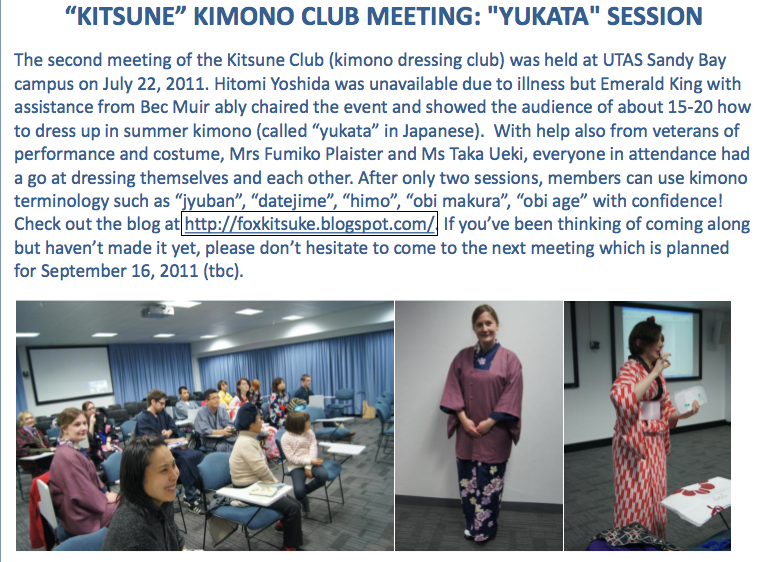
This meeting we practiced dressing in yukata and folding kimono with the help of members of the AJS.
-Emerald introduced the differences between formal 'kimono school' style and 'street style.'


The difference between (image on the left) - a seijinshiki (coming of age day) formal ensemble that took 3 hours for hair, makeup and kitsuke - and (image on the left) - a komon (all over pattern kimono) with heels and white wig informal ensemble put together for the cosplay catwalk. The first is very bulky using lots of towels to get my curvey western body all the one shape from hips to bust. The second uses no towels and binding cords (datejime) to surpress the bust. Both outfits use a fukuro obi (formal sash).

-Member Rebecca and Emerald did a kistuke demonstration showing two ways to dress in yukata using himo (strings), datejime and corin belts. Emerald showed how to tie a hanhaba obi (half width obi) into a bunkyou musubi (a bow like knot that is used with yukata and worn under hakama).

-The group tried on yukata supplied by Emerald, Miriam and Hitomi or wore their own. Those who had experience in kitsuke were able to help those in the group who had less (or no) experience.

-The possibility of a kimono event was raised with Barbara making the fantastic suggestion that we should aim for a display in the Morris Miller Library.

-Affiliation with the UTAS student union was raised and it was decided that we should affiliate.

-The group learnt how to fold kimono and yukata and helped to put the yukata away.

Sorry for the lateness of these very brief minutes. Thank you to everyone who helped look for my manky brown datejime. It somehow made its way into my bag when I wasn't looking so all is well! Thank you to those who attended and helped to make it a good meeting. Thank you for baring with me while I made way through the meeting without the help of Hitomi sensei who was sick.

Tuesday, 19 July 2011

Stepping out in style

New contributor here! It's Cassandra from the Exec, Midori was nice enough to let me contribute to the blog. It may be a little early to start discussing footwear but I can't help it. I love shoes!
Midori and I were talking about how to add some semblance of a ohashori (the fold at the hips) to your outfit if it's too short by pulling your kimono / yukata higher than you usually would and showing more of your feet and ankles.

One great way to make use of all this extra viewing area is to wear some funky shoes. While geta and zori are traditional you can add some flair to your outfit by trying something different. Heels and boots look great with outfits that have kimono and yukata pulled higher than usual and dressy sandals and wedges look great peaking out from underneath. Here are a few examples of kitsuke using non-traditional footwear:

The silver heels in the middle are a classic example of using minor accessories to help colour coordinate your outfit. The silver of the heels match her obi and the little silver design on her outfit perfectly. Her shoes also make her outfit a little more 'dressy' than a regular pair of geta would.


I'm including this collage because I love it. Her boots work with both the pink and the black hakama. With the pink outfit her shoes match because her black gloves balance the mix of darker tones with the bright colours. Your eyes are not immediately drawn to her shoes, they're a lovely touch without over-powering the look.
With the black hakama her boots almost emerge seamlessly out from underneath, giving her feet a beautiful, slender appearance.

So when you're all planning your next outfit look at your shoe collection and experiment a little. Who knows what you can come up with using things you already have in your own wardrobe!
-Cass

I love wearing shoes with kimono! It's hard for me to find kimono that are the right length. However, by wearing western shoes (high heels and boots) I'm able to wear my kimono and hakama shorter (above ankle to mid calf if I'm feeling daring) than if I was wearing geta or formal zori (which demand that the kimono hem is no higher than the top of the foot). Wearing western accessories with kimono date back to the Meiji period! - E

Monday, 11 July 2011

Feature in UNITAS


We were featured in UNITAS (The University of Tasmania's monthly publication)
You can find the article at the UTAS Media website

Sunday, 10 July 2011

Next Meeting 22July 2011


There will be a video link between the Launceston and Hobart campuses of the University of Tasmania.
In this meeting we will practice dressing in yukata. If you have one, please bring it along although there will be some garments available to borrow.

Wednesday, 8 June 2011

Useful Books #1

The following is a list of useful books in English taken from the Ichiroya FAQ page link. This page also has details on how to wear kimono and kimono information such as the differences between men's, women's and children's kimono and kitsuke.

The Book of Kimono / The Complete Guide to Style and Wear
by Norio Yamanaka
Kodansha

Kimono:Vanishing Tradition
by Cheryl Imperatore & Paul Maclardy
A Schiffer Book for Designers & Collectors

Japanese Costume
by Helen Benton Minnich
Tuttle(Kodansha or Weatherhill imprimatur)

To make a kimono for yourself--

MAKE YOUR OWN JAPANESE CLOTHES
by John Marshall
Kodansha International

To learn about textiles and designs of kimono--

The Ultimate SASHIKO SOURCEBOOK
by Susan Briscoe
David & Charles

Textile Art of Japan
by Sunny Yang, Rochelle M. Narasin
Shufunotomo Co.,LTD

Design with Japanese Obi
by Diane Wiltshire & Ann Whitshire
Charles E. Tuttle Company
*It is full of obi display hint with beautiful photos.

Japanese Costume and Textile Arts
by Seiroku Noma
Heibonsha series on Japanese arts
review by Mr Jaxo Nobori
It has seen a number of printings, so several editions are readily available on the 'used' book market. It deals mostly with Noh costume tradition and Momoyama/Genroku kosode.

Kimono
by Liza Dalby
review by Mr Jaxon Nobori
This is the most recent (and arguably the best). She is a cultural anthropologist by training, who studied the geisha of Kyoto in-depth and actually hired-out as one for a period of time. Besides writing a book on her experiences called "Geisha", she has also written a fictionalized autobiography of "Murasaki Shikibu", the authoress of Genji Monogatari / The Tale of Genji

SYMBOLS OF JAPAN
by Merrily Baird

SNOW, WAVE, PINE
by Sadao Hibi and Motoji Niwa

WHEN ART BECAME FASHION, Kosode in Edo Period Japan
by Dale Carolyn Gluckman and Sharon Sadako Takeda